Most resume bullets describe a job. The ones that get read describe what a person did in it. The difference is small on the page, often a verb and a number, and it decides whether a line tells the reader anything they could not have guessed from the job title.
This is a guide to writing the second kind. It needs no tool, only your memory of the work. The last section covers how WingsOnCV checks and rewrites bullets, and what it refuses to do.
Start with what a weak bullet looks like
A weak bullet is a line from the job description, pasted under your name. It says what the role was responsible for, which is true of everyone who ever held it.
Responsible for managing customer accounts and handling escalations.
Managed 40 business accounts and resolved escalated complaints, most within one working day.
Nothing was invented between those two lines. The writer already knew how many accounts they had and how fast they usually closed a complaint. The first version left it out.
The shape: verb, what, result
A bullet that works has three parts, in this order.
Not every line has a measurable result, and you should not force one. "Trained six new starters on the till system" has a verb and a scope, and is a good bullet.
Openers to retire, and what to write instead
| Weak opener | Why it is weak | Try |
|---|---|---|
| Responsible for... | Names a duty, not an action. You can be responsible for something and do it badly. | Managed, ran, owned, delivered |
| Worked on... | Hides your part. Did you lead it, build it or attend the meetings? | Built, designed, wrote, tested, shipped |
| Helped with / Assisted in... | Makes you a bystander to someone else's work. | The verb for your actual part: drafted, analysed, coordinated, prepared |
| Duties included... | A list of tasks with no outcome. | One bullet per task that mattered, each with its own verb |
| Successfully... | An adverb doing the job a result should do. | Drop the word and state the result |
Use the verb that is true
"Led" is stronger than "supported", but only if you led. An interviewer will ask about any bullet they like, and the verb is the first thing they test. A precise modest verb reads better than an inflated one you have to walk back.
Where numbers come from when you think you have none
People in sales have targets. Everyone else tends to assume they have no numbers. Almost every job has four kinds, and you can usually recall them without looking anything up.
| Kind of number | The question to ask yourself | Examples |
|---|---|---|
| Scale | How many, how big? | Customers served per shift, accounts, pupils in a class, lines of code, beds on the ward, budget |
| Frequency | How often? | Reports per month, releases per week, deliveries per day, calls per hour |
| Time | How long did it take, and how long does it take now? | Turnaround, time to close, time saved on a task, a deadline met |
| Scope | How far did it reach? | Team size, number of sites, countries, departments, systems |
A number does not have to be impressive. Its job is to make the line specific.
Estimate honestly, never invent
If you know roughly, say roughly: "about 30", "up to 15 a day", "a team of five". If you do not know, leave the number out and let the verb and scope carry the line. A made-up percentage is the one thing on a resume that can end an interview.
Before and after, across five kinds of job
Customer service
Answered customer calls and emails.
Answered about 60 calls and emails a day for a broadband provider, and wrote the reply templates the team now uses for billing questions.
Software
Worked on improving the performance of the checkout page.
Cut checkout page load time from 4 seconds to under 2 by removing unused scripts and deferring image loading.
Teaching
Responsible for teaching maths to Year 9 students.
Taught maths to three Year 9 classes of 28, and ran a weekly lunchtime clinic for pupils preparing for the end-of-year exam.
Operations and warehouse
Helped with stock control and deliveries.
Checked in up to 15 deliveries a day and ran the weekly stock count for a 2,000-line warehouse.
Nursing
Duties included patient care and medication rounds.
Cared for up to 8 patients per shift on a 24-bed surgical ward, including medication rounds and handover notes for the night team.
In every pair the second line is longer, and that is fine. It replaced a phrase the reader would skip with facts they can picture.
One idea per bullet, and how long is too long
- One idea. If a bullet has "and" joining two unrelated achievements, split it. Each then gets its own verb and its own chance to be noticed.
- Two lines at most. A bullet that runs to three lines on the page is a paragraph. Cut the setup and keep the action and the result.
- Three to five per role. More for the current job, fewer as you go back.
- Lead with the strongest. Readers skim the first bullet under each title. Put the one most relevant to the job you want there.
How WingsOnCV helps, and where it stops
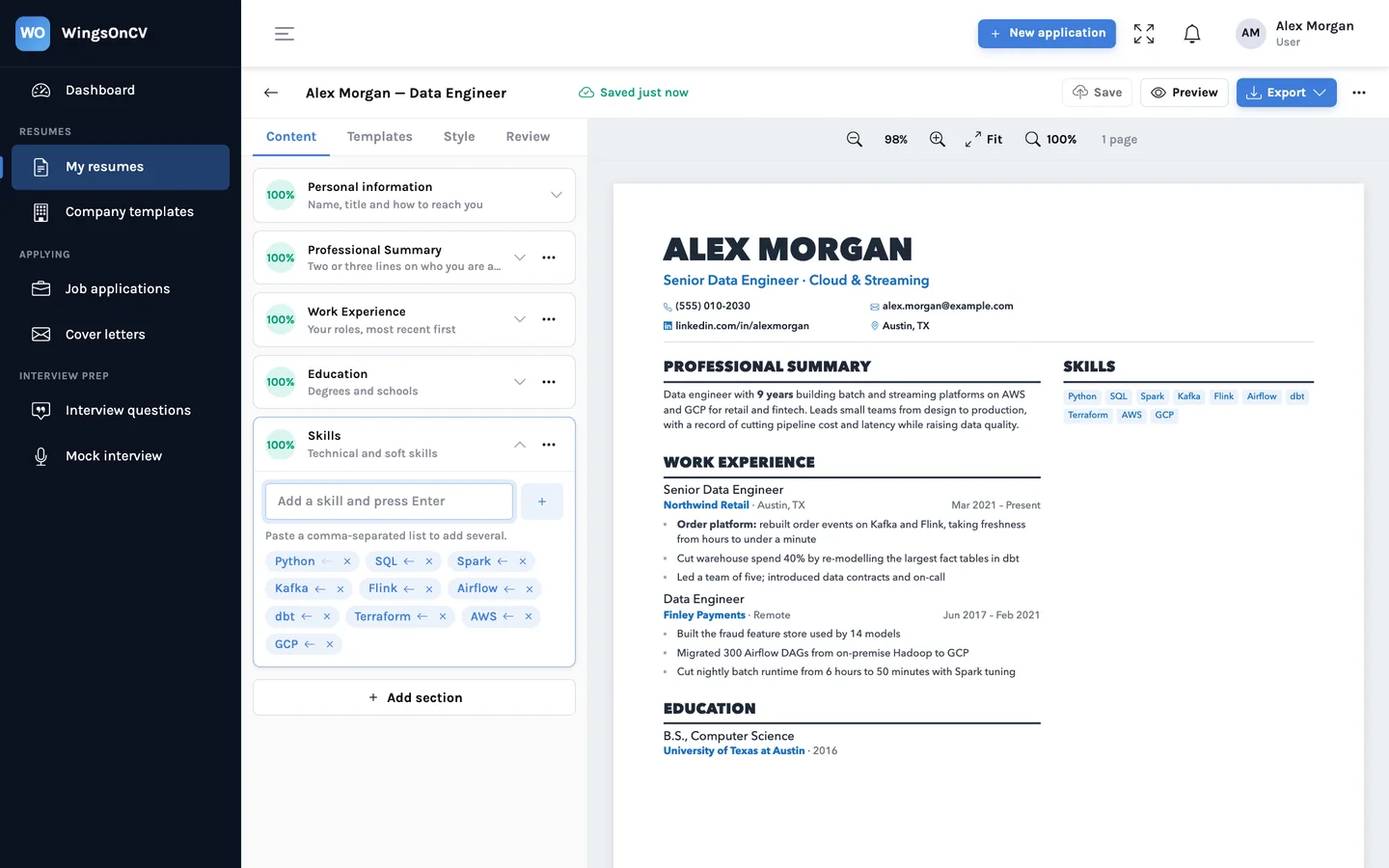
The product does two things to make this quicker: it shows where the bullets need work, and it offers a rewrite you can accept or discard.
The Review tab finds the weak lines
The Review tab reads the resume and reports what it finds: the share of bullets that carry a number, how many start with a weak opener such as "Responsible for" or "Worked on", how many run past 38 words, and whether any role has fewer than two bullets. Paste a job posting and it also lists which of the posting's terms your resume covers and which it does not.
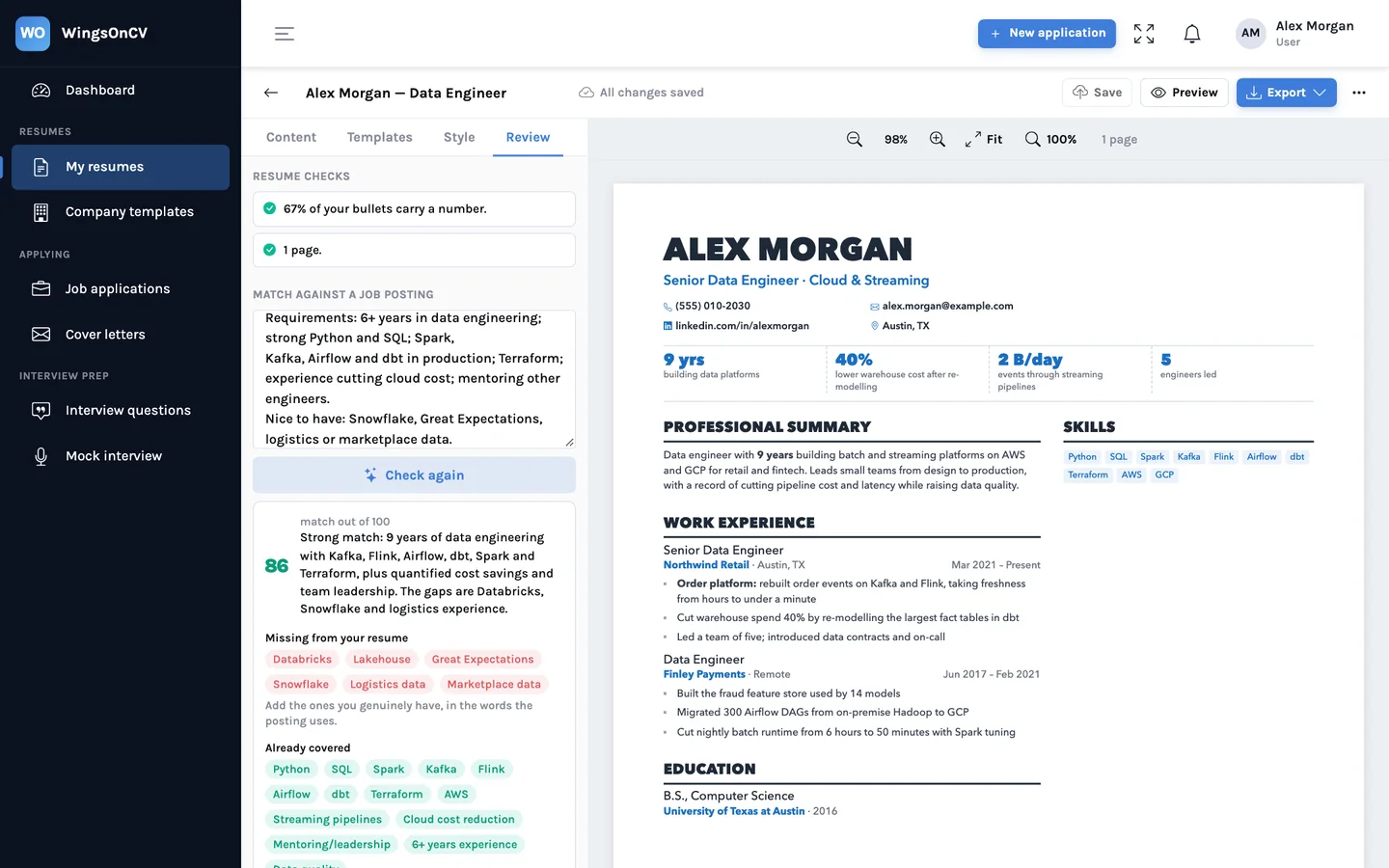
The missing list is a prompt, not an instruction. Add a term only if you have really done the work, in a bullet about that work. The method is in how to tailor a resume to a job.
"Improve with AI" rewrites, using only what is there
In the editing panel, the summary and each role's bullets have an Improve with AI button, with options to make the text shorter or to put results first. It shows a suggestion under your original. You choose Use this or Discard; nothing changes until you do.
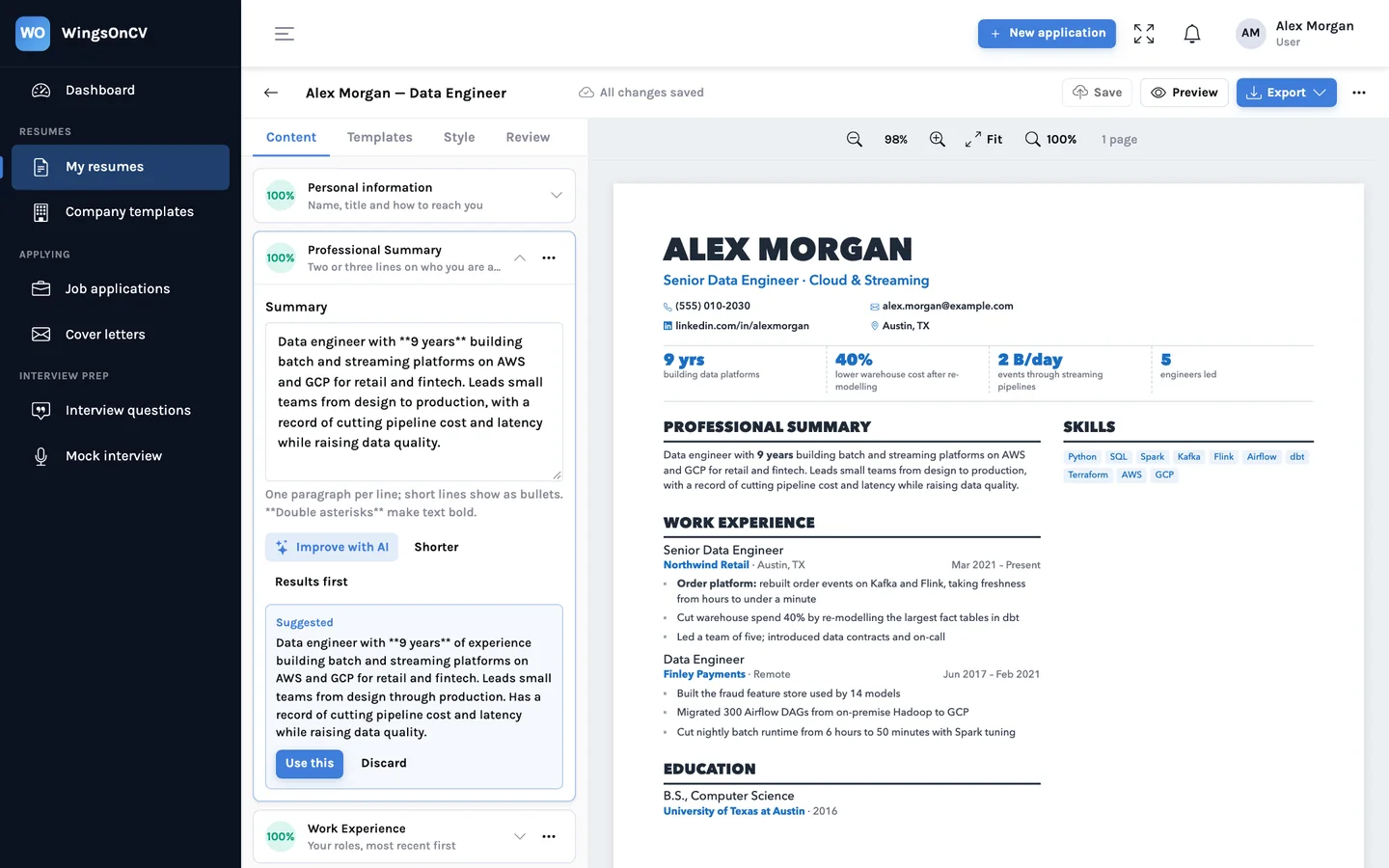
The rewrite works under one rule: it may only use what the text already says. It can replace "Responsible for" with a real verb, reorder a sentence so the result comes first, and cut filler. It will not add a number, a tool, an employer or an outcome that is not in your text.
That limit is deliberate
If your bullet has no number, the improved bullet has no number. The tool cannot know that you served 120 customers a shift; only you can. Add the fact yourself, then ask for the rewrite. Why the rule exists and how it is enforced is covered in why our AI is not allowed to make things up.
So the order that works is: you supply the facts, the tool helps with the wording.
A checklist for every bullet
- It starts with a past-tense verb that describes what I did, not what the role was.
- It names what I did it to, with a size, a count or a scope where I honestly know one.
- It ends with a result, or the scope is specific enough to stand on its own.
- Every number is one I could explain in an interview. Rough ones are marked as rough.
- It holds one idea and fits on two lines.
- I have removed "responsible for", "worked on", "helped with", "duties included" and "successfully".
A duty is what the job asked for. A bullet is what you did about it.
Run the check on your own bullets
Upload your resume, open the Review tab, and see which lines carry a number and which only name a duty.
Create your account