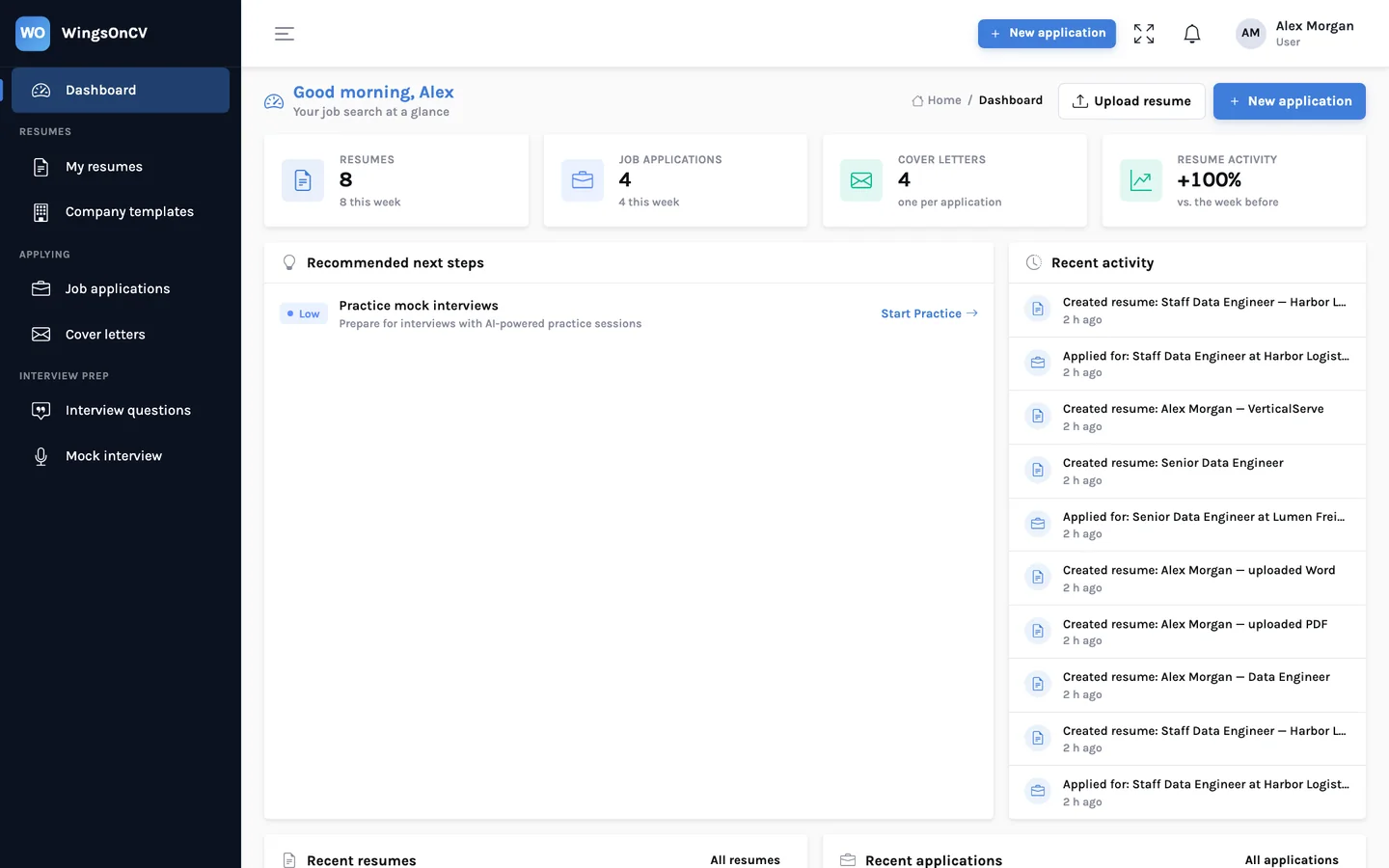
Ask a general-purpose AI to "make my resume fit this job" and it will often do exactly that, in the most direct way available: it reads that the posting wants Snowflake, and Snowflake appears in your skills. It reads "PMP preferred" and a certification turns up. The result looks stronger and is no longer your resume.
WingsOnCV uses AI for tailoring, for restructuring a resume into a different format, and for rewriting a single bullet or summary. All of it works under one rule, and this post explains that rule plainly: what it is, where it is enforced, how we test it, and where it stops and your own reading has to take over.
Why a made-up line is worse than a missing one
A resume is a set of claims you will be asked about. Each added skill is a question you cannot answer in the interview. Each added certification is something a background check can fail to find. Employers can and do withdraw offers, and end employment later, over statements on a resume that turn out not to be true.
So the cost of a fabricated line is not shared with the tool that wrote it. It lands on you, and usually at the worst moment: in the room, or after you have resigned from your current job. A gap on the page is a smaller problem than a claim you cannot support.
A gap on the page is a smaller problem than a claim you cannot support.
The rule
Every AI feature in WingsOnCV may re-order and re-word what your resume already says. It may not add to it. In practice that means the following.
| The AI may | Allowed? | The AI may not | Allowed? |
|---|---|---|---|
| Move the most relevant role, bullet or skill higher | Yes | Add an employer, job title or date | No |
| Describe your work in the posting's terms, where those terms are true of it | Yes | Add a degree, certification or licence | No |
| Shorten, tighten or split a bullet | Yes | Add a tool, language or technology you did not list | No |
| Rewrite a summary to lead with what this job cares about | Yes | Add or change a number, percentage or team size | No |
| Leave out material that does not matter for this job | Yes | Claim a responsibility the resume does not describe | No |
The left column is what a careful friend would do with your resume and an evening to spare. The right column is what that friend would refuse to do. The product is meant to behave like the friend.
What that looks like on one bullet
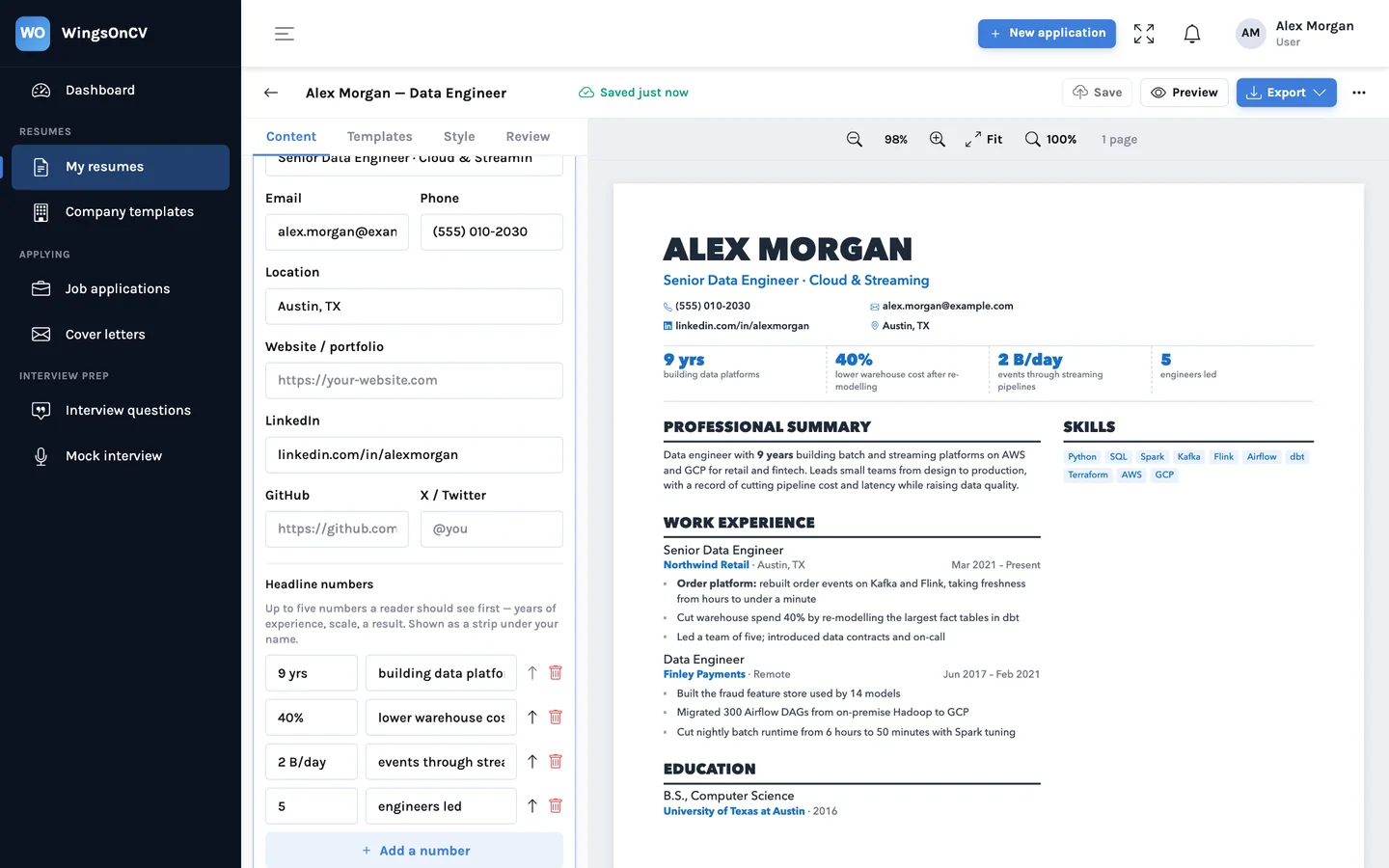
Take a real line from the fictional resume used in our screenshots, and a posting that asks for "experience cutting cloud cost" and lists Snowflake as a nice-to-have.
Fabricated: Cut Snowflake warehouse spend 55% by re-modelling the largest fact tables and introducing FinOps governance across three teams.
Honest: Cut cloud warehouse cost 40% by re-modelling the largest fact tables in dbt.
The original bullet said "Cut warehouse spend 40% by re-modelling the largest fact tables in dbt". The honest rewrite borrows the posting's phrase, "cloud cost", because it is a fair description of the same work. The fabricated one names a product the resume never mentions, raises the number, and invents a governance programme. The first is tailoring. The second is fiction with your name on it.
Where the rule lives
A rule that exists only in a help article does nothing. This one is built into the product in three places.
- In the instructions for every AI feature. Tailoring to a job, restructuring into a company format and "Improve with AI" each carry the same instruction: use only the facts in the resume you were given, and add none.
- In what the model is given. The model receives your resume, the posting when there is one, and the rules. It has no access to the web, to other people's resumes, or to anything else it could borrow "typical" experience from.
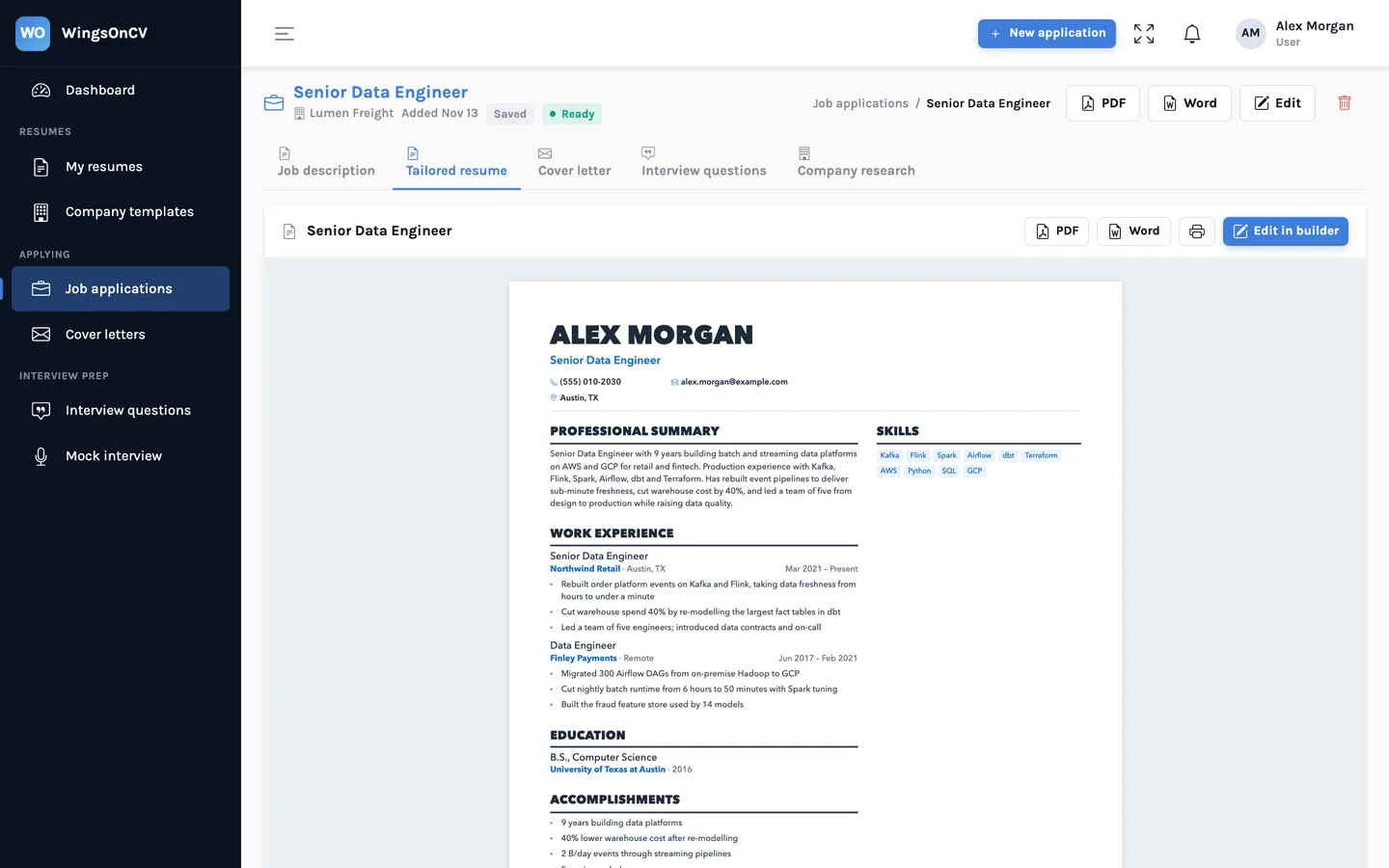
- In what happens to the result. A tailored resume is saved as a separate copy with the application it was written for. It keeps your template, your layout and your contact details, and your original resume is never overwritten.
How we check it
Instructions to a model are not a guarantee, so the rule is also tested. Before a release, an automated run signs in as a test user, creates an application from a real-looking posting, and waits for the tailored resume. It then checks the result against the source: the employers in the original must still be there. If tailoring had dropped or replaced where the person worked, the run fails and the release does not go out.
That test is deliberately narrow. Employers are the facts that matter most and are easiest to verify mechanically. It does not prove that every sentence is one you would have written, which is why the next section exists.
The honest limits
We would rather tell you where the rule is weak than have you find out in an interview.
- Wording can be stronger than you would choose. "Led" where you would say "co-led". "Expert" where you would say "experienced". No fact was added, but the emphasis moved. You are the only one who knows where the line is.
- A model can misread. If your resume is ambiguous about who did what, a rewrite may resolve the ambiguity in your favour. Fix the source so it is clear.
- Leaving things out changes the picture. Tailoring drops what is less relevant. Make sure nothing you consider essential went with it.
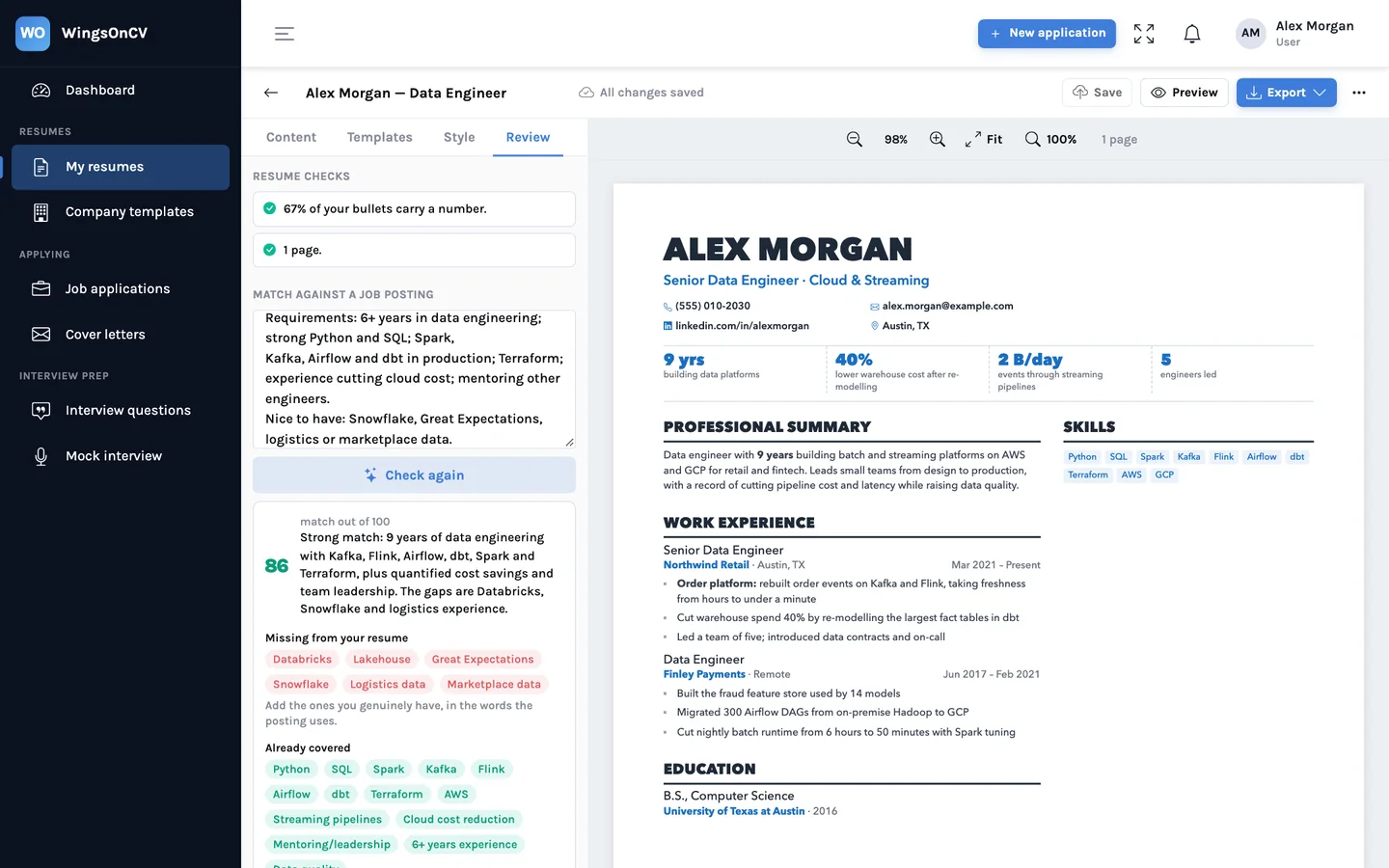
- Keywords you do not have stay missing. The review shows which of the posting's terms your resume does not cover. It lists them so you can add the ones that are true. It does not add them for you.
You are responsible for your resume
WingsOnCV produces a draft for you to check. Whatever you download and send is your statement to an employer, so read every line of it first.
You approve every change
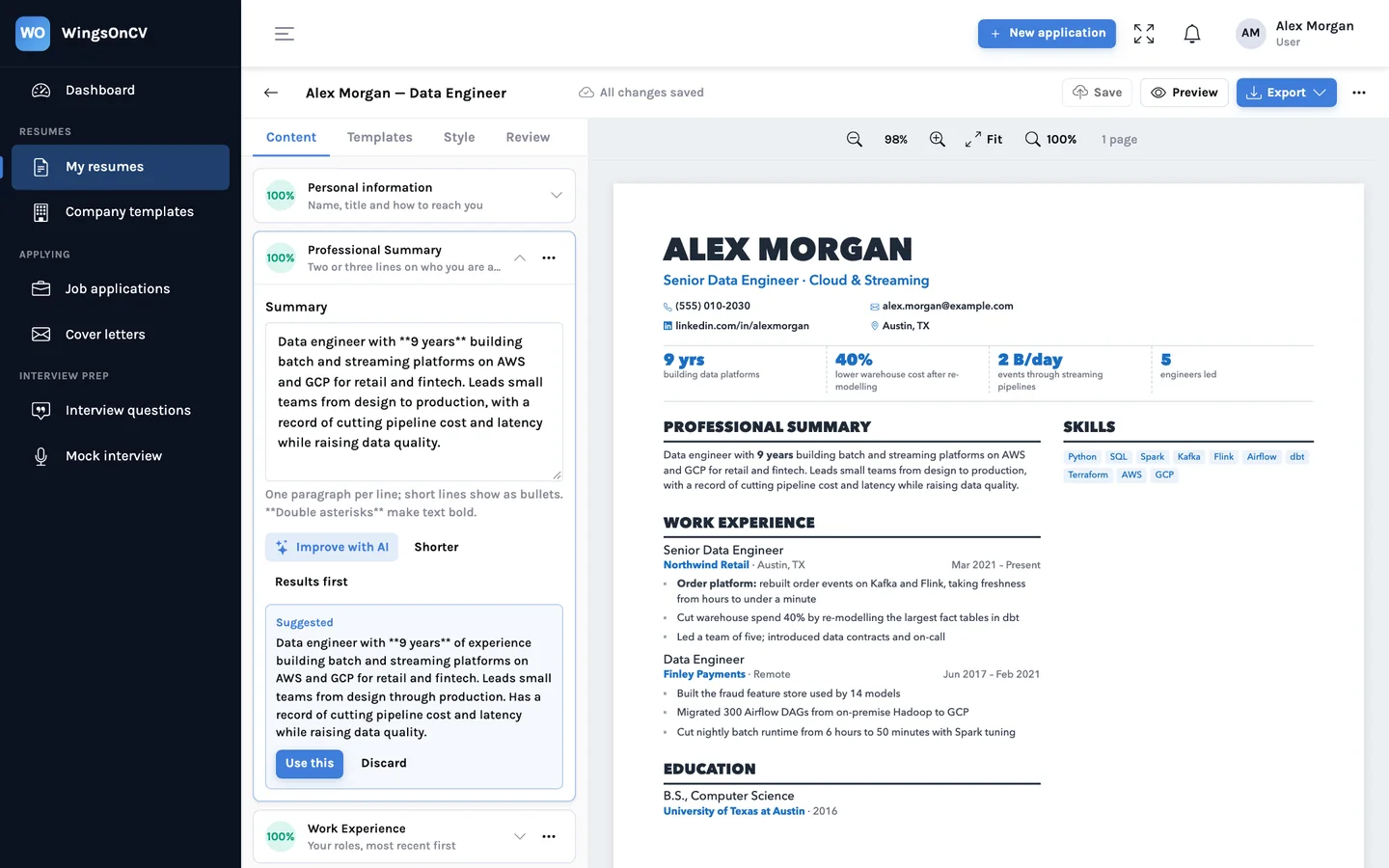
Rewriting a single section works the same way at a smaller scale. "Improve with AI" shows its suggestion next to your original text and waits. Nothing on the page changes until you choose to use it, and you can discard it or edit it afterwards like any other text.
What to check before you send
Two minutes with this list is worth more than any score.
- Every employer, job title and date matches your original.
- Every number is one you can explain: where it came from and how it was measured.
- Every tool and skill listed is one you could answer a detailed question about.
- Degrees and certifications are exactly as awarded, with the right institution and year.
- Verbs match your real role: led, co-led, contributed to, supported.
- Nothing important to you was dropped when the content was re-ordered.
- You could talk for two minutes about any bullet on the page.
If a tailored resume ever contains something that was not in your source, tell us through the contact page. That is a bug in the thing this product is built around, and we treat it as one. For the method behind honest tailoring, see how to tailor a resume to a job; for how your data is handled, see how we protect your resume.
See what tailoring does to your own resume
Upload the resume you have, paste a posting, and compare the tailored copy with the original line by line.
Create your account